
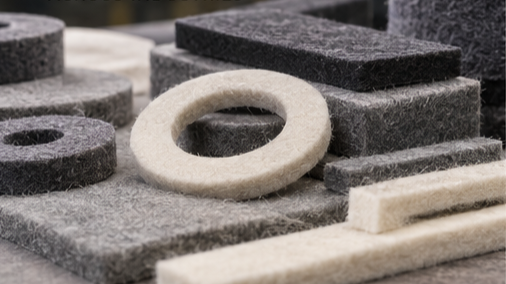
Common Industrial Applications for Nonwoven Wool Felt: 7 Industries That Depend on Technical Felt
From automotive manufacturing and aerospace to woodworking, printing, and wire production, discover how industrial wool felt and engineered nonwoven materials support modern manufacturing.
Industrial manufacturing depends on materials that deliver reliable performance under demanding operating conditions. While metals, plastics, and rubber receive much of the attention in component design, nonwoven wool felt remains an essential engineering material across a surprisingly diverse range of industries.
Its combination of resilience, compressibility, absorbency, insulation, and adaptability makes industrial wool felt useful for applications ranging from machinery lubrication to precision-cut gaskets and protective components.
Unlike woven textiles, traditional pressed wool felt is manufactured by interlocking natural wool fibers through controlled heat, moisture, pressure, and mechanical action. The resulting material can be produced in various densities and thicknesses to meet specific industrial requirements.
At Southeastern Felt & Supply Corp. (SEFCO), we have been supplying and converting industrial textiles since 1958. Our product expertise extends beyond pressed wool felt to include synthetic nonwovens, woven felts, specialty high-temperature materials, foam, and rubber.
These capabilities allow us to serve manufacturers requiring both raw materials and custom-fabricated components.
Below, we explore seven important industries that rely on technical felt materials and explain how the right material selection can improve manufacturing efficiency, equipment performance, and product reliability.
1. Automotive Manufacturing: Noise Reduction, Sealing, and Vibration Control
The automotive industry is one of the most versatile markets for engineered nonwoven textiles.
Modern vehicles contain numerous components designed to control noise, vibration, friction, and unwanted contact between adjacent surfaces.
Industrial wool felt and synthetic nonwoven materials can provide effective solutions for these applications.
Automotive Felt Applications
Common automotive applications include:
Anti-squeak and anti-rattle pads
Noise and vibration dampening components
Interior protective liners
Seating and headliner materials
Dust shields and protective barriers
Custom adhesive-backed felt components
Gaskets, seals, and cushioning materials
One particularly important application is the management of buzz, squeak, and rattle (BSR).
As vehicle manufacturers work to improve passenger comfort, reducing incidental noise from interior components becomes increasingly important.
Properly selected nonwoven materials can provide cushioning between contacting surfaces and help minimize unwanted noise.
This is especially relevant in electric vehicles, where the absence of conventional engine noise can make other vehicle sounds more noticeable.
Custom Automotive Felt Converting
Automotive manufacturers frequently require precisely shaped components rather than standard sheets of material.
Southeastern Felt offers die cutting, kiss cutting, and adhesive coating capabilities for automotive applications.
These processes allow technical felt materials to be converted into custom parts designed for specific assemblies.
Material selection depends on requirements such as thickness, density, temperature exposure, abrasion resistance, and adhesive compatibility.
Explore our Automotive Felt Solutions.
2. Aerospace and Defense: Specialized Felt Components for Demanding Environments
Aerospace manufacturing requires careful material selection, dimensional consistency, and attention to application-specific specifications.
Wool felt and other engineered nonwoven materials have applications in commercial aviation, defense equipment, and related manufacturing operations.
Common Aerospace Felt Applications
Potential uses include:
Acoustic insulation materials
Protective lining components
Oil-wicking seals
Equipment cushioning
Precision-cut gaskets and washers
Specialized high-temperature insulation components
Surface protection during assembly and maintenance
One of the useful characteristics of wool felt is its ability to absorb and retain lubricating oils.
In appropriately designed systems, this can make felt suitable for wicking and lubrication-related components.
Wool felt can also provide cushioning and surface protection in assemblies where controlled contact between components is necessary.
High-Temperature Nonwoven Materials
Not every aerospace application can use natural wool felt.
Where operating temperatures exceed the suitable range for wool, specialized synthetic or high-temperature nonwoven materials may be required.
Materials such as aramid-based felt can offer alternative performance characteristics for certain thermal applications.
Southeastern Felt supplies a range of industrial nonwoven materials and custom-converted components to support specialized aerospace requirements.
All critical applications should be evaluated against the relevant material specifications, testing requirements, and operating conditions.
Explore our Aerospace Felt Products.
3. Woodworking and Forestry Products: High-Density Felt for Industrial Sanders
One of the more specialized applications for industrial felt is found in woodworking and engineered wood manufacturing.
Facilities producing medium-density fiberboard (MDF), high-density fiberboard (HDF), particleboard, hardwood products, and other wood-based materials frequently rely on industrial sanding equipment.
These machines operate continuously in demanding production environments.
Felt Platen Components for Wide-Belt Sanders
High-density industrial felt is used in selected sanding equipment to provide a controlled interface between machine components and abrasive systems.
Depending on equipment design, felt platen materials help distribute pressure and support consistent sanding performance.
These components are particularly important in:
Wide-belt sanding machines
Orbital sanding equipment
Industrial finishing systems
Particleboard production
MDF and HDF manufacturing
Wood panel processing
When platen materials wear or deteriorate, sanding consistency and surface finish can be affected.
Replacement Industrial Sander Felt
Maintenance departments often require replacement platen felt to keep sanding equipment operating efficiently.
Southeastern Felt supplies a range of materials for sanding applications, including high-density sheet felt, woven felt, and specialty treated materials.
Our product offerings include SuperFelt, a specialty resin-treated material developed for demanding sanding applications.
The correct replacement depends on equipment design, operating conditions, and the original material requirements.
For maintenance managers, access to suitable replacement materials can help reduce unnecessary equipment downtime and support consistent production quality.
Explore our Industrial Sanding Felt Solutions.
4. Printing and Packaging: Felt Wipers, Ink Separators, and End Seals
Industrial printing equipment relies on carefully controlled fluid transfer, wiping, and sealing processes.
Felt materials are particularly useful in selected printing applications because they combine absorbency with resilience and conformability.
Industrial Printing Felt Applications
Common products include:
Bearer wiper felts
Fountain end felts
Ink separators
Ink dams
Flexographic end seals
Specialized wiping and sealing components
In printing equipment, felt components may be required to maintain contact with moving surfaces while providing a controlled wiping or sealing function.
The material must be selected to balance compression, wear resistance, fluid compatibility, and dimensional requirements.
Flexographic Printing End Seals
Flexographic printing presents unique challenges because sealing components must manage ink while accommodating moving rollers and related equipment.
Southeastern Felt has developed specialized felt-and-neoprene combinations for certain flexographic end-seal applications.
Combining different materials can allow manufacturers to tailor the sealing component to the mechanical and fluid-management requirements of the printing process.
Custom Printing Components
Printing equipment varies considerably by manufacturer and model.
As a result, replacement components often require precise dimensions and specific material characteristics.
Southeastern Felt offers custom manufacturing capabilities for printing felt components and related seals.
Explore our Printing Felt and End Seal Products.
5. Wire Manufacturing: Felt Applicators for Magnet Wire Enameling
Wire manufacturing is another specialized industrial market where felt performs an important function.
In the production of magnet wire, manufacturers apply insulating enamel coatings to conductive wire.
Consistent coating application is essential for achieving the required electrical and mechanical properties of the finished product.
Felt Applicators in Magnet Wire Production
Felt applicators can be used to transfer enamel coatings onto wire as it passes through a production line.
In certain coating systems, the enamel is heated to achieve suitable processing characteristics before being applied through the felt.
The coated wire then passes through a curing oven to form the finished insulating layer.
The felt applicator must provide consistent contact and fluid distribution.
Important material considerations include:
Density and compressibility
Coating compatibility
Absorption and fluid transfer
Dimensional consistency
Wear characteristics
Operating temperature
Wire Cleaning and Surface Preparation
Felt materials can also serve selected wiping and cleaning functions in wire processing operations.
Properly designed components help control contact with the wire surface and support repeatable processing conditions.
For wire manufacturers, the correct felt specification can be an important part of maintaining coating consistency and production efficiency.
Explore our Wire Manufacturing Felt Applications.
6. Orthopedic and Medical Applications: Cushioning and Pressure Distribution
Although industrial wool felt is commonly associated with machinery, nonwoven felt materials also serve important roles in orthopedic and medical-related products.
These applications take advantage of the material's compressibility, softness, and ability to be fabricated into specialized shapes.
Common Orthopedic Felt Products
Applications include:
Metatarsal pads
Heel cushioning pads
Protective foot padding
Orthotic components
Splint and cast padding
Custom pressure-relief components
Medical and orthopedic felts may contain wool, cotton, rayon, or other fibers depending on the intended product.
For example, cotton-containing felt blends can be selected for applications where moisture management and comfort are important.
Custom Medical Felt Converting
Orthopedic components frequently require precise shapes and thicknesses to accommodate different anatomical and product requirements.
Southeastern Felt offers custom converting services for orthopedic, orthotic, and podiatry applications.
Materials intended for medical use must be evaluated for the appropriate performance, safety, and regulatory requirements.
Explore our Orthopedic Felt Products.
7. Craft, Furniture, and Consumer Product Manufacturing
Nonwoven felt also has a significant role in commercial craft products, furniture manufacturing, and consumer goods.
While these applications may appear less technically demanding than aerospace or automotive manufacturing, consistent material quality and fabrication remain important.
Common Felt Applications
Products include:
Adhesive-backed felt pads
Furniture protection pads
Decorative felt components
Felt sheets and rolls
Protective surface liners
Industrial craft components
Custom-cut consumer product parts
Furniture manufacturers, for example, frequently incorporate felt pads to help protect finished floors and other surfaces from scratching.
Adhesive-backed felt can also provide cushioning and surface protection in consumer product assemblies.
Converting Capabilities
Southeastern Felt supplies felt sheets, tapes, pads, and custom-cut components for a variety of commercial and consumer applications.
Different applications may require natural wool, synthetic fibers, or blended materials.
Material thickness, color, adhesive selection, and component geometry can all be customized according to the product requirements.
Explore our Craft and Home Felt Products.
Beyond Traditional Markets: Additional Industrial Uses for Wool Felt
The seven industries above represent established markets served by Southeastern Felt, but the applications for industrial felt extend considerably further.
Mining and Aggregate Processing
Heavy industrial equipment may use felt for selected sealing, wiping, cushioning, and lubrication functions.
Components must be evaluated for abrasive exposure, moisture, loading, and equipment operating conditions.
Pulp and Paper Manufacturing
Industrial felt components may be used in machinery wiping, sealing, and lubrication systems.
These should be distinguished from specialized paper-machine clothing, which often uses engineered synthetic structures.
Steel and Metal Processing
Felt can provide protective contact surfaces, wiping functions, and lubrication support in selected metalworking operations.
Material selection must account for temperature, abrasion, and exposure to processing fluids.
General OEM and MRO Manufacturing
Across industrial markets, original equipment manufacturers and maintenance departments use custom felt gaskets, washers, strips, seals, and protective components.
These applications demonstrate that nonwoven wool felt is not limited to one industry or type of equipment.
Why Material Selection Matters in Industrial Felt Applications
Although wool felt is highly versatile, no single material grade is suitable for every industrial application.
Engineers and purchasing professionals should evaluate several characteristics before specifying a felt component.
Material composition: Natural wool, synthetic fibers, and blended materials offer different performance characteristics.
Density: Influences firmness, compressibility, fluid retention, and wear behavior.
Thickness: Affects component fit, cushioning, and sealing characteristics.
Temperature resistance: Must be compatible with the intended operating environment.
Chemical compatibility: Oils, solvents, coatings, and other process fluids may influence material performance.
Dimensional tolerances: Precision components require appropriate fabrication methods and inspection requirements.
Applicable specifications: Certain industries require material grades conforming to recognized SAE, military, or customer-specific standards.
Selecting the correct material can help improve component reliability and avoid unnecessary replacement costs.
Custom Industrial Felt Fabrication: From Raw Material to Finished Component
For many industrial customers, purchasing felt in sheet or roll form is only the beginning.
The material must often be converted into a precision component designed for a particular machine or manufacturing process.
Southeastern Felt offers fabrication services including:
Die cutting
CNC cutting
Waterjet cutting
Slitting and rewinding
Adhesive coating
Custom manufacturing
Product design assistance
These capabilities allow industrial customers to source custom felt components rather than performing additional fabrication in-house.
Whether the requirement involves a simple felt washer or a more complex OEM component, material selection and converting methods should be considered together.
For purchasing professionals, working with an experienced converter can simplify sourcing and support consistency across repeat orders.
Partner With Southeastern Felt & Supply Corp.
For more than six decades, Southeastern Felt & Supply Corp. has supplied industrial textiles and custom-fabricated components to manufacturers across a diverse range of markets.
From automotive and aerospace to woodworking, printing, wire manufacturing, and orthopedic applications, our expertise extends across both natural wool felt and engineered synthetic materials.
We understand that successful industrial components require more than the right raw material.
They require appropriate specifications, reliable converting processes, and an understanding of how the finished product will perform in its intended application.
Whether your company needs custom die-cut felt gaskets, lubrication wicks, industrial sander felt, printing seals, automotive liners, or specialized OEM components, Southeastern Felt can help evaluate your requirements.
Request a Quote for Custom Industrial Felt Components
Looking for an experienced industrial felt supplier or custom textile converter?
Request a Quote from Southeastern Felt & Supply Corp.
Our team can review your material specifications, drawings, production quantities, and application requirements to help identify a suitable solution.
Frequently Asked Questions About Industrial Wool Felt Applications
What industries use nonwoven wool felt?
Nonwoven wool felt is used in automotive manufacturing, aerospace, industrial machinery, woodworking, printing, wire production, and numerous OEM and maintenance applications. Related synthetic and blended nonwoven materials serve additional markets.
What are the most common uses for industrial wool felt?
Common applications include gaskets, seals, washers, lubrication wicks, protective pads, machinery wipers, and vibration-dampening components.
Can wool felt be used in automotive manufacturing?
Yes. Wool felt and other technical nonwovens can be used in automotive cushioning, sealing, surface protection, and noise-control applications, depending on the component requirements.
What type of felt is used in industrial sanding machines?
Depending on equipment design, industrial sanders may use high-density pressed wool felt, woven felt, or specialty treated materials as platen components.
Why is felt used in magnet wire manufacturing?
Felt applicators can help distribute enamel coatings onto wire during manufacturing. Their absorbency, compressibility, and contact characteristics make them suitable for certain coating systems.
Can industrial felt be custom die-cut?
Yes. Industrial wool felt and many synthetic nonwovens can be die-cut, CNC-cut, waterjet-cut, or otherwise converted into custom components.
Where can I purchase custom industrial felt components?
Southeastern Felt & Supply Corp. supplies industrial felt materials and custom-fabricated components for OEM and MRO applications. Customers can submit specifications and drawings through the company's online quotation request page.