
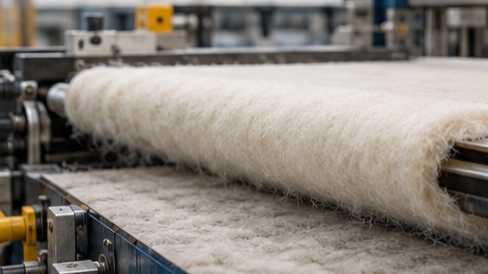
How Is Wool Felt Made? From Raw Wool to Industrial-Grade Nonwoven Felt
An inside look at the wool felt manufacturing process, material properties, and how natural wool fibers become precision-engineered industrial components.
Wool felt is one of the oldest manufactured textiles in the world, yet it remains an essential material in modern industrial applications. From automotive components and aerospace equipment to industrial machinery and lubrication systems, nonwoven wool felt continues to provide manufacturers with a versatile combination of durability, resilience, and absorbency.
But how is wool felt made, and what transforms loose natural wool fibers into a dense, uniform material capable of meeting demanding industrial specifications?
Unlike conventional woven fabrics, wool felt is manufactured by interlocking fibers through a combination of moisture, heat, pressure, and mechanical action. This process produces a cohesive nonwoven textile that can be manufactured in different densities, thicknesses, and grades.
At Southeastern Felt & Supply Corp., we specialize in industrial felt materials and custom-fabricated components. Understanding how wool felt is manufactured helps engineers, purchasing professionals, and equipment manufacturers select the appropriate material for their applications.
What Is Wool Felt?
Wool felt is a nonwoven textile made by consolidating wool fibers into a dense, interconnected structure.
Unlike woven fabrics, which are constructed by interlacing yarns, traditional pressed wool felt relies on the natural characteristics of wool fibers to form a cohesive material.
Wool fibers have microscopic overlapping scales along their surfaces. When exposed to moisture, heat, and mechanical agitation, these fibers can migrate and interlock with one another.
As this process continues, the fibers become increasingly entangled, producing a stable textile structure.
The resulting material offers several useful industrial properties:
Natural resilience and compressibility
Oil absorption and retention
Thermal insulation
Sound and vibration dampening
Resistance to fraying when cut
Adaptability to custom shapes and dimensions
These characteristics make industrial wool felt suitable for components such as gaskets, seals, washers, lubrication wicks, protective pads, and machinery wipers.
Step 1: Selecting and Preparing Raw Wool
The wool felt manufacturing process begins with the selection of raw wool fibers.
Not all wool is identical. Fiber diameter, length, crimp, and quality influence the characteristics of the finished felt.
Manufacturers select wool based on the desired performance of the final material.
For example, certain applications may require a softer, more compressible felt, while others benefit from a denser and firmer material.
Before manufacturing begins, raw wool typically undergoes several preparation processes.
Cleaning and Scouring
Raw wool contains natural grease, dirt, and other impurities acquired during the animal's growth and shearing.
The wool is washed through a process known as scouring, which removes much of this unwanted material.
Proper cleaning is important because contaminants can interfere with consistent felting and affect the performance of the finished product.
Opening and Blending
After cleaning and drying, the wool fibers are mechanically opened to separate compressed clusters.
Different wool types or fiber lots may be blended to achieve more consistent material characteristics.
Some industrial felt grades also incorporate other fibers, depending on the intended application and material specification.
The prepared wool is then ready for carding.
Step 2: Carding the Wool Fibers
Carding is a critical stage in manufacturing nonwoven wool felt.
During this process, wool fibers pass through specialized machinery equipped with fine wire-covered rollers.
These rollers separate, straighten, and distribute the fibers into a relatively uniform web.
The purpose of carding is to create a consistent fiber distribution before the material enters the felting process.
Uniformity is particularly important in industrial applications, where variations in material thickness or density can affect the performance of finished components.
Multiple layers of carded wool may be combined to build the desired starting weight and thickness.
The resulting structure is often referred to as a wool batt.
At this stage, the fibers are loosely arranged and have not yet been consolidated into the dense structure associated with finished industrial felt.
Step 3: Felting Through Heat, Moisture, and Mechanical Action
The defining stage of traditional wool felt manufacturing is the felting process itself.
The wool batt is exposed to controlled combinations of moisture, heat, pressure, and mechanical agitation.
These conditions encourage the microscopic scales on wool fibers to interact, allowing fibers to migrate and progressively interlock.
As the process continues, the wool structure becomes increasingly compact.
The material shrinks in area while increasing in density and cohesion.
This transformation is what distinguishes traditional pressed wool felt from many other nonwoven textiles.
Why Do Wool Fibers Interlock?
Wool fibers have a natural scaly surface and a characteristic response to moisture and mechanical movement.
During felting, the fibers move against one another and gradually become entangled.
Their surface structure helps resist movement in the reverse direction, contributing to progressive consolidation.
The resulting material does not require a conventional woven construction to maintain its integrity.
For industrial applications, the felting process is carefully controlled to produce the required material properties.
Step 4: Fulling and Densification
After the initial felting stage, the material may undergo additional mechanical processing known as fulling.
Fulling further consolidates the wool fibers, increasing the density and firmness of the material.
This stage is especially important when producing industrial-grade wool felt.
Different applications require different levels of density.
For example:
Softer felt may be preferred for cushioning and protective padding.
Medium-density felt may be suitable for selected wiping and sealing applications.
Higher-density felt may be specified for applications requiring greater firmness, wear resistance, or dimensional stability.
The relationship between density and performance is not always straightforward.
Increasing density can improve certain mechanical properties while reducing the available pore space for fluid retention.
For lubrication applications, manufacturers must balance absorbency, firmness, and the ability to release oil at the desired rate.
This is why selecting the correct wool felt grade is essential.
Step 5: Washing, Drying, and Finishing
Following felting and fulling, the material undergoes finishing operations.
These may include washing, rinsing, drying, pressing, and surface finishing.
The specific sequence depends on the manufacturing method and the required final properties.
Thickness Control
Industrial felt is produced in a range of nominal thicknesses.
Manufacturers control thickness through the starting fiber weight, degree of consolidation, and finishing processes.
Surface Finishing
Depending on the application, felt may be pressed or otherwise finished to improve surface consistency.
Dimensional Stabilization
Controlled drying and finishing help establish the material's final dimensions.
Because wool is a natural fiber, it can respond to changes in humidity and temperature. Manufacturers account for these characteristics when establishing material specifications and tolerances.
The finished felt is then prepared for inspection and conversion into sheets, rolls, or fabricated components.
Step 6: Quality Inspection and Industrial Specifications
For industrial customers, consistent material quality is essential.
Finished wool felt may be evaluated for several properties, including:
Thickness
Density
Fiber composition
Tensile strength
Compression characteristics
Dimensional consistency
Visual appearance and material uniformity
The required testing depends on the intended application and applicable specifications.
Industrial Wool Felt Grades
Industrial wool felt is available in various grades, including materials manufactured to recognized standards such as SAE J314 and legacy military specifications where applicable.
These specifications can define requirements relating to material composition, density, thickness, and other performance characteristics.
For engineers and purchasing managers, referencing an established material specification can help communicate requirements and support consistent sourcing.
However, a felt grade designation alone does not guarantee suitability for every application. Operating conditions and finished-component requirements must also be considered.
Step 7: Converting Wool Felt Into Industrial Components
Once the wool felt has been manufactured, the material can be converted into finished industrial products.
This is where the capabilities of an experienced industrial felt supplier become especially valuable.
Many OEMs and maintenance departments do not require full sheets or rolls of wool felt. Instead, they need precision-fabricated components designed for specific equipment.
Custom Die-Cut Wool Felt
Die cutting allows wool felt to be manufactured into repeatable shapes and dimensions.
Common products include:
Industrial wool felt gaskets
Felt washers and spacers
Machinery wipers
Protective pads
Lubrication wicks
Felt strips and seals
Custom OEM components
Depending on the geometry and production volume, felt can also be processed using other precision-cutting methods.
Material Selection and Tolerances
The converting process must account for the characteristics of the felt itself.
Material density, thickness, compressibility, and fiber structure can influence cutting performance and dimensional tolerances.
For applications requiring close tolerances, the material grade and fabrication method should be evaluated together.
At Southeastern Felt & Supply Corp., our focus is helping industrial customers source the appropriate felt materials and custom-fabricated components for their manufacturing requirements.
Pressed Wool Felt vs. Needle-Punched Felt: What's the Difference?
One important distinction in the industrial textile industry is the difference between traditional pressed wool felt and needle-punched felt.
Although both are nonwoven materials, they are manufactured differently.
Pressed Wool Felt
Traditional pressed wool felt relies on the natural felting properties of wool fibers.
Heat, moisture, pressure, and mechanical agitation encourage the fibers to interlock.
This process produces a cohesive material commonly used for industrial sealing, lubrication, cushioning, and wiping applications.
Needle-Punched Felt
Needle-punched felt is manufactured by repeatedly passing barbed needles through a fiber web.
The needles mechanically entangle the fibers, creating a consolidated nonwoven structure.
Needle punching can be used with wool, polyester, aramid, and other fibers.
This method is common in industrial filtration, automotive components, protective textiles, and numerous engineered nonwoven products.
The key difference is that traditional pressed wool felt depends primarily on the natural felting behavior of wool, while needle-punched felt uses mechanical needle entanglement to consolidate the fibers.
Both manufacturing methods can produce useful industrial materials, but their properties must be evaluated against the requirements of the intended application.
Why Does the Manufacturing Process Matter?
Understanding how wool felt is made helps industrial buyers make better material decisions.
Manufacturing variables influence the finished material's performance.
For example, the degree of fiber consolidation can affect density, firmness, compressibility, and fluid absorption.
Fiber selection can influence resilience and material uniformity.
Finishing processes can affect thickness consistency and dimensional stability.
These factors become particularly important in applications involving:
Continuous machinery operation
Controlled lubrication
Repeated compression
Abrasive contact
Tight component tolerances
OEM production requirements
A properly specified industrial felt component can support equipment reliability and help reduce maintenance-related disruptions.
Industrial Applications for Manufactured Wool Felt
The versatility of wool felt allows it to serve a wide range of industrial markets.
Automotive: Sealing, cushioning, protective liners, and selected lubrication components.
Aerospace and defense: Specialized pads, wipers, seals, and protective components manufactured to applicable requirements.
Heavy machinery: Oil-retaining felt, bearing lubrication, wiping components, and equipment protection.
Metalworking: Lubrication systems, surface protection, and selected wiping applications.
Printing equipment: Felt wipers, seals, and fluid-management components.
OEM and MRO: Custom replacement components, gaskets, washers, and machinery pads.
Each application requires careful consideration of the operating environment and material characteristics.
Choosing the Right Industrial Wool Felt Supplier
When sourcing industrial wool felt, price and availability are only part of the equation.
Manufacturers should also consider material consistency, specification requirements, converting capabilities, and supply reliability.
An experienced supplier can help customers evaluate:
Appropriate wool felt grades
Material thickness and density
Required fiber composition
Component dimensions and tolerances
Production quantities
Application-specific requirements
For OEMs, repeatability and reliable sourcing are especially important.
For maintenance professionals, finding an appropriate replacement component can help minimize equipment downtime.
Partner With Southeastern Felt & Supply Corp.
From raw wool selection and fiber preparation to felting, finishing, and precision converting, the manufacturing process transforms a natural fiber into a versatile industrial engineering material.
Understanding these steps helps manufacturers identify the right material for their applications and make more informed purchasing decisions.
Southeastern Felt & Supply Corp. specializes in supplying industrial wool felt and custom-fabricated textile components for OEM and MRO applications.
Whether your requirements involve industrial gaskets, seals, lubrication wicks, machinery pads, or precision die-cut components, our team can help you evaluate material options and sourcing requirements.
Looking for industrial wool felt or custom felt components?
Contact Southeastern Felt & Supply Corp. to discuss your specifications, request material information, or obtain a quotation for your next project.
Frequently Asked Questions About Wool Felt Manufacturing
How is wool felt made?
Traditional wool felt is manufactured by cleaning, carding, and layering wool fibers before consolidating them using moisture, heat, pressure, and mechanical agitation. The fibers interlock to form a dense, cohesive nonwoven textile.
Is wool felt woven or nonwoven?
Wool felt is a nonwoven textile. Unlike woven fabric, traditional pressed wool felt is formed by interlocking fibers rather than weaving yarns together.
What is industrial wool felt made from?
Industrial wool felt is manufactured from wool fibers, although certain grades may incorporate other fibers. Composition depends on the product specification and intended application.
What is the difference between pressed wool felt and needle-punched felt?
Pressed wool felt uses the natural felting behavior of wool fibers, while needle-punched felt uses barbed needles to mechanically entangle fibers. The two processes produce materials with potentially different characteristics.
Can wool felt be manufactured in different thicknesses and densities?
Yes. Industrial wool felt is available in numerous thicknesses, densities, and grades. These variations allow manufacturers to select materials for cushioning, lubrication, sealing, wiping, and other applications.
Can industrial wool felt be custom die-cut?
Yes. Finished industrial wool felt can be fabricated into custom gaskets, washers, pads, seals, strips, and other precision components using die cutting and additional converting methods.