
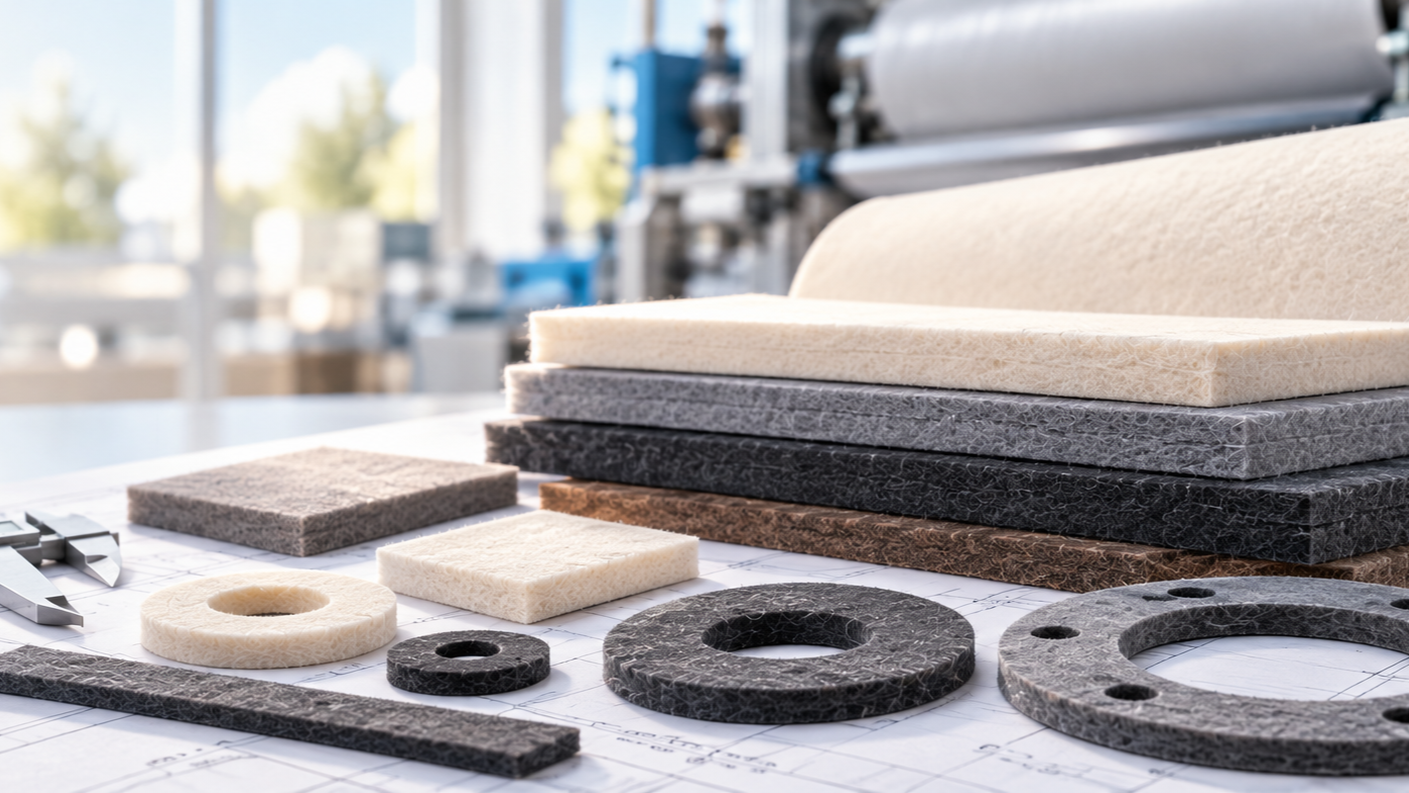
Key Performance Properties of Nonwoven Wool Felt: An Industrial Material Guide
Understanding density, compression, oil absorption, durability, and thermal performance in industrial wool felt applications.
When selecting materials for industrial manufacturing, engineers and purchasing professionals must evaluate more than simply thickness, appearance, or cost. The physical and mechanical properties of a material determine how effectively it will perform under operating conditions and whether it can deliver reliable service over time.
Nonwoven wool felt is one of the most versatile industrial textile materials, offering a unique combination of compressibility, resilience, absorbency, insulation, and adaptability.
These characteristics have made wool felt a valuable material in automotive manufacturing, aerospace, industrial machinery, wire production, printing equipment, and numerous OEM and maintenance applications.
However, not all wool felt performs the same way.
Material density, fiber composition, manufacturing methods, and finishing processes can significantly influence performance.
At Southeastern Felt & Supply Corp. (SEFCO), we specialize in supplying industrial felt materials and custom-fabricated components for demanding applications. Understanding the key performance properties of nonwoven wool felt helps manufacturers select the appropriate material grade and avoid unnecessary performance issues.
Below, we examine eight important properties that engineers and industrial buyers should consider.
1. Wool Felt Density: A Critical Performance Characteristic
Density is one of the most important properties of industrial wool felt.
It describes the mass of material contained within a given volume and is commonly expressed in pounds per cubic foot (lb/ft³) or kilograms per cubic meter (kg/m³).
Density influences the firmness, compressibility, fluid retention, and wear characteristics of felt.
How Density Affects Wool Felt Performance
Lower-density felt generally contains more open space between fibers, making it softer and more compressible.
Higher-density felt typically has a more compact fiber structure, resulting in greater firmness and resistance to deformation.
Depending on the material grade, different densities may be selected for:
Soft cushioning and protective padding
Lubrication wicks and oil-retaining components
Machinery seals and gaskets
Industrial wiping applications
High-density equipment pads
Precision-cut washers and spacers
For example, a cushioning application may benefit from a relatively soft material, while a machinery wiper may require a firmer felt capable of maintaining controlled contact with a moving surface.
Why Density Matters to Engineers
Selecting felt based solely on thickness can lead to inconsistent results.
Two materials with identical thicknesses may perform very differently if their densities differ.
For industrial applications, specifying both density and thickness helps establish more consistent material requirements.
Engineering takeaway: Density should be considered alongside compression, absorbency, and operating conditions rather than treated as an isolated specification.
2. Compression and Resilience: Performance Under Mechanical Load
One of the defining characteristics of wool felt is its ability to compress under pressure.
Wool fibers have a naturally crimped structure that provides elasticity and resilience.
When consolidated into felt, these fibers create a material capable of cushioning mechanical contact.
Compression Resistance
Compression resistance describes how a material responds when a load is applied.
For industrial felt, this characteristic is particularly important in applications involving:
Machinery cushioning
Protective pads
Industrial gaskets
Equipment spacers
Vibration-control components
Repeated mechanical contact
A softer felt may compress significantly under relatively low loads.
A denser felt may offer greater resistance to compression.
The appropriate balance depends on the application.
Compression Recovery
Compression recovery refers to the ability of a material to regain thickness after a load is removed.
Wool felt can demonstrate useful recovery characteristics under suitable conditions, but recovery is not unlimited.
Sustained loading, excessive compression, elevated temperatures, and repeated cycling can cause permanent deformation.
For applications requiring consistent component thickness or sealing pressure, compression behavior should be evaluated under realistic operating conditions.
Engineering takeaway: When specifying felt for gaskets or cushioning, evaluate both initial compressibility and long-term compression set.
3. Oil Absorption and Lubrication Retention
One of the most valuable industrial properties of wool felt is its ability to absorb and retain lubricating oils.
Wool fibers are naturally capable of interacting with moisture, while the interconnected spaces within felt can retain and transport liquids through capillary action.
This makes wool felt particularly useful in selected lubrication systems.
Industrial Lubrication Applications
Common applications include:
Bearing lubrication pads
Oil-retaining washers
Machinery lubrication wicks
Felt oilers
Industrial wiping components
Oil distribution systems
In these applications, felt can act as a reservoir that holds lubricant and gradually delivers it to a designated contact surface.
What Determines Oil Absorption?
Several factors influence the absorption and retention characteristics of wool felt:
Density: More compact materials generally contain less open pore volume, although pore structure and wetting behavior also matter.
Thickness: Thicker components may provide greater total fluid-holding capacity.
Fiber composition: Wool content and blended fibers influence liquid interaction.
Lubricant viscosity: Thicker oils may move through felt differently than lower-viscosity fluids.
Operating temperature: Temperature can change lubricant viscosity and flow behavior.
Absorption vs. Release
An important distinction is that a material capable of holding a large amount of oil may not necessarily release it at the desired rate.
Lubrication applications require a balance between retention and controlled fluid delivery.
Engineering takeaway: For oil-wicking applications, test the actual lubricant and felt combination rather than relying on absorbency alone.
4. Abrasion Resistance and Mechanical Durability
Industrial felt components are frequently exposed to friction, repetitive movement, and contact with adjacent surfaces.
Abrasion resistance describes a material's ability to withstand wear caused by rubbing or mechanical contact.
Wool felt can provide useful abrasion performance in appropriate applications, particularly when the correct density and grade are selected.
Common Wear-Related Applications
Examples include:
Industrial machinery wipers
Protective contact pads
Surface-cleaning components
Equipment liners
Selected sealing applications
Industrial polishing and finishing components
How Density Influences Wear
Higher-density wool felt often provides greater firmness and structural stability than softer grades.
However, abrasion resistance also depends on fiber characteristics, surface finish, contact pressure, speed, and the presence of abrasive contaminants.
For example, a felt wiper operating against a smooth lubricated surface will experience different wear conditions than one exposed to dust or abrasive particles.
Improving Component Service Life
Engineers should consider:
Contact pressure
Relative surface speed
Operating temperature
Lubrication conditions
Abrasive contamination
Required component lifespan
In certain applications, a synthetic felt or specialized treated material may provide better wear performance than natural wool.
Engineering takeaway: The most durable felt is not necessarily the densest material; it is the grade best matched to the operating environment.
5. Thermal Insulation and Temperature Resistance
Wool felt provides useful thermal insulation because its fiber structure contains numerous small air spaces.
These air spaces help slow heat transfer through the material.
As a result, wool felt may be suitable for selected insulation and temperature-management applications.
Common Thermal Applications
Potential uses include:
Equipment insulation pads
Protective thermal barriers
Temperature-sensitive component separation
Machinery insulation
Selected transportation components
Natural Flame Resistance
Wool has inherent flame-resistant characteristics compared with many common textile fibers.
It generally requires relatively high temperatures to ignite and tends to char rather than melt.
However, natural flame resistance does not mean wool felt is suitable for every high-temperature or fire-rated application.
Operating temperature, exposure duration, oxygen availability, material density, and any chemical treatments must be considered.
Applications involving continuous high temperatures may require specialized alternatives such as aramid or other engineered high-temperature nonwovens.
Thermal Performance Considerations
Engineers should evaluate:
Continuous operating temperature
Maximum intermittent temperature
Thermal conductivity
Material thickness
Compression under operating load
Applicable flammability requirements
Engineering takeaway: Never substitute general wool-fiber properties for product-specific thermal or flammability test data.
6. Acoustic Insulation and Vibration Dampening
Noise and vibration can affect equipment performance, operator comfort, and product quality.
Nonwoven wool felt can help manage certain mechanical vibrations and incidental contact noise through its fibrous structure and compressibility.
How Wool Felt Reduces Noise
When sound energy enters a porous material, interactions between moving air and fibers can dissipate some of that energy.
Wool felt can also provide a cushioning interface between contacting surfaces, reducing certain rattles and impact noises.
These functions are distinct from sound blocking, which depends heavily on mass and assembly construction.
Common Applications
Industries using felt for noise or vibration management include:
Automotive manufacturing
Industrial machinery
Appliance manufacturing
Equipment enclosures
Furniture and product assemblies
In automotive applications, felt components may be used to reduce buzz, squeak, and rattle between adjacent surfaces.
For industrial equipment, felt pads can help limit incidental contact noise and protect mating components.
Material Selection
The effectiveness of felt for acoustic and vibration applications depends on:
Density
Thickness
Frequency of vibration
Applied load
Mounting method
Contact geometry
Engineering takeaway: Acoustic absorption, vibration isolation, and anti-rattle cushioning are different functions and should be evaluated separately.
7. Dimensional Stability and Precision Fabrication
For original equipment manufacturers, material performance must be accompanied by consistent dimensions.
Industrial wool felt is frequently converted into custom shapes that must fit precisely within mechanical assemblies.
Common components include:
Die-cut wool felt gaskets
Felt washers
Machinery seals
Protective pads
Lubrication wicks
Felt strips
Custom OEM components
Why Dimensional Stability Matters
Because wool is a natural fiber, its dimensions can respond to humidity, temperature, compression, and mechanical loading.
The manufacturing process, material density, and finishing operations influence the dimensional behavior of the finished felt.
These characteristics become particularly important when producing precision components.
Custom Die-Cut Felt Components
At Southeastern Felt & Supply Corp., industrial felt materials can be fabricated using processes such as die cutting, CNC cutting, waterjet cutting, and slitting.
The appropriate fabrication method depends on component geometry, material thickness, production quantity, and tolerance requirements.
Tolerances and Inspection
Engineers should specify:
Nominal thickness and allowable variation
Critical component dimensions
Material grade
Required density
Inspection requirements
Relevant operating conditions
For particularly demanding applications, prototype evaluation can help establish whether the selected material and cutting method meet the required tolerances.
Engineering takeaway: Precision fabrication begins with choosing a material grade whose natural variation and compression behavior are compatible with the component design.
8. Chemical Compatibility and Environmental Performance
Industrial felt components may be exposed to oils, lubricants, solvents, cleaning agents, humidity, and other process conditions.
Chemical compatibility is therefore an important material-selection consideration.
Moisture Absorption
Wool is hygroscopic, meaning its fibers can absorb water vapor from the surrounding environment.
This property can be beneficial in some applications, but it can also influence material dimensions and mechanical behavior.
Wool felt is not inherently waterproof.
Oil and Lubricant Compatibility
Wool felt is widely used in selected oil-lubrication applications, but compatibility should be verified with the specific lubricant and operating conditions.
Chemical Exposure
Strong acids, alkalis, oxidizing agents, and certain processing chemicals can damage wool fibers.
For chemically aggressive environments, synthetic materials may offer more suitable performance.
Environmental Considerations
Wool is a renewable natural fiber and is biodegradable under suitable conditions.
These characteristics can be attractive to manufacturers evaluating sustainable material alternatives.
However, the environmental footprint of a finished felt component also depends on sourcing, processing, transportation, product life, and disposal.
Engineering takeaway: Chemical compatibility and environmental suitability must be assessed for the complete application, not simply the fiber type.
Understanding Industrial Wool Felt Grades and Specifications
Industrial wool felt is manufactured in multiple grades designed to provide different physical and mechanical characteristics.
Recognized specifications help engineers and purchasing professionals communicate material requirements.
One commonly referenced standard is SAE J314, which addresses felted wool and wool-blend materials for industrial applications.
Legacy military specifications and customer-specific material requirements may also be encountered.
Depending on the specification, material requirements may address characteristics such as:
Fiber composition
Density
Thickness
Tensile properties
Compression behavior
Other defined physical characteristics
When selecting a material, engineers should verify the exact grade and applicable revision of the specification.
A designation alone does not establish suitability for a particular operating environment.
Comparing Wool Felt Properties
PropertyPrimary Engineering ConsiderationTypical ApplicationDensityFirmness and compression behaviorGaskets, pads, wipersCompression recoveryThickness recovery after loadingCushioning and sealingOil absorptionFluid retention and deliveryLubrication wicksAbrasion resistanceWear under mechanical contactMachinery wipersThermal performanceHeat transfer and temperature exposureInsulation padsAcoustic performanceNoise absorption and contact cushioningAutomotive linersDimensional stabilityComponent fit and tolerance controlPrecision die-cut partsChemical compatibilityResistance to operating fluidsIndustrial seals and wipers
This table provides a starting point for material selection. Actual performance should be verified against the requirements of the finished component.
Wool Felt vs. Synthetic Felt: Which Performs Better?
Natural wool felt is not always the best choice for every application.
Synthetic nonwoven materials such as polyester, aramid, and other engineered fibers may offer advantages in certain operating environments.
For example, polyester felt can provide useful dimensional consistency and resistance to certain chemicals, while specialized aramid materials may be more appropriate for elevated-temperature applications.
Wool felt remains attractive where natural resilience, compressibility, oil retention, and other characteristic properties are beneficial.
The appropriate selection depends on the application.
Engineers should consider operating conditions, material specifications, component geometry, and expected service life before choosing between wool and synthetic alternatives.
Choosing the Right Industrial Felt Supplier
Material selection is only one part of developing a successful industrial component.
Manufacturers also need reliable sourcing, appropriate fabrication methods, and consistent quality.
An experienced industrial felt supplier can help evaluate:
Required material composition
Appropriate density and thickness
Applicable SAE or customer specifications
Custom component geometry
Manufacturing tolerances
Production volumes
Operating environment
Material documentation requirements
For OEM customers, repeatability and supply reliability are essential.
For maintenance departments, selecting a suitable replacement component can help minimize equipment downtime.
Industrial Wool Felt Solutions from Southeastern Felt & Supply Corp.
Understanding the performance properties of nonwoven wool felt is essential to selecting the right material for an industrial application.
Density, compression, oil absorption, abrasion resistance, thermal behavior, and dimensional stability all influence how a felt component performs.
The correct combination of these properties can support equipment reliability, consistent manufacturing performance, and longer component service life.
Southeastern Felt & Supply Corp. specializes in supplying industrial wool felt, synthetic nonwovens, and custom-fabricated textile components for OEM and MRO applications.
Our capabilities include material sourcing and precision converting for industries such as automotive, aerospace, woodworking, printing, wire manufacturing, and general industrial equipment.
Whether your application requires custom wool felt gaskets, industrial seals, lubrication wicks, protective pads, or precision die-cut components, our team can help evaluate your requirements.
Request a Quote for Industrial Wool Felt Components
Looking for a reliable industrial felt supplier?
Request a Quote from Southeastern Felt & Supply Corp.
Share your material specifications, drawings, quantities, and operating requirements with our team to discuss a suitable solution.
Frequently Asked Questions About Industrial Wool Felt Properties
What are the main properties of nonwoven wool felt?
The primary properties include compressibility, resilience, oil absorption, thermal insulation, acoustic absorption, abrasion performance, and adaptability to custom fabrication. Actual characteristics vary by material grade and density.
How does wool felt density affect performance?
Density influences firmness, compressibility, pore structure, and wear behavior. Higher-density materials are generally firmer, while lower-density materials are often softer and more compressible.
Is wool felt good for absorbing oil?
Yes. Wool felt is commonly used in industrial lubrication applications because its fiber structure can retain and transport lubricating oils. Performance depends on material grade, density, and lubricant characteristics.
Can wool felt withstand high temperatures?
Wool has natural thermal insulation and flame-resistant characteristics, but its suitability depends on the operating temperature and exposure conditions. Specialized high-temperature materials may be required for more demanding applications.
What is SAE wool felt?
SAE wool felt refers to felt materials specified under applicable Society of Automotive Engineers standards, including SAE J314. These specifications provide requirements for defined material grades.
Can wool felt be precision die-cut?
Yes. Industrial wool felt can be converted into custom gaskets, washers, pads, seals, strips, and other components using die cutting and related fabrication methods.
Where can I buy industrial wool felt?
Southeastern Felt & Supply Corp. supplies industrial wool felt materials and custom-fabricated components for OEM and maintenance applications. Customers can request quotations through the company's website.